
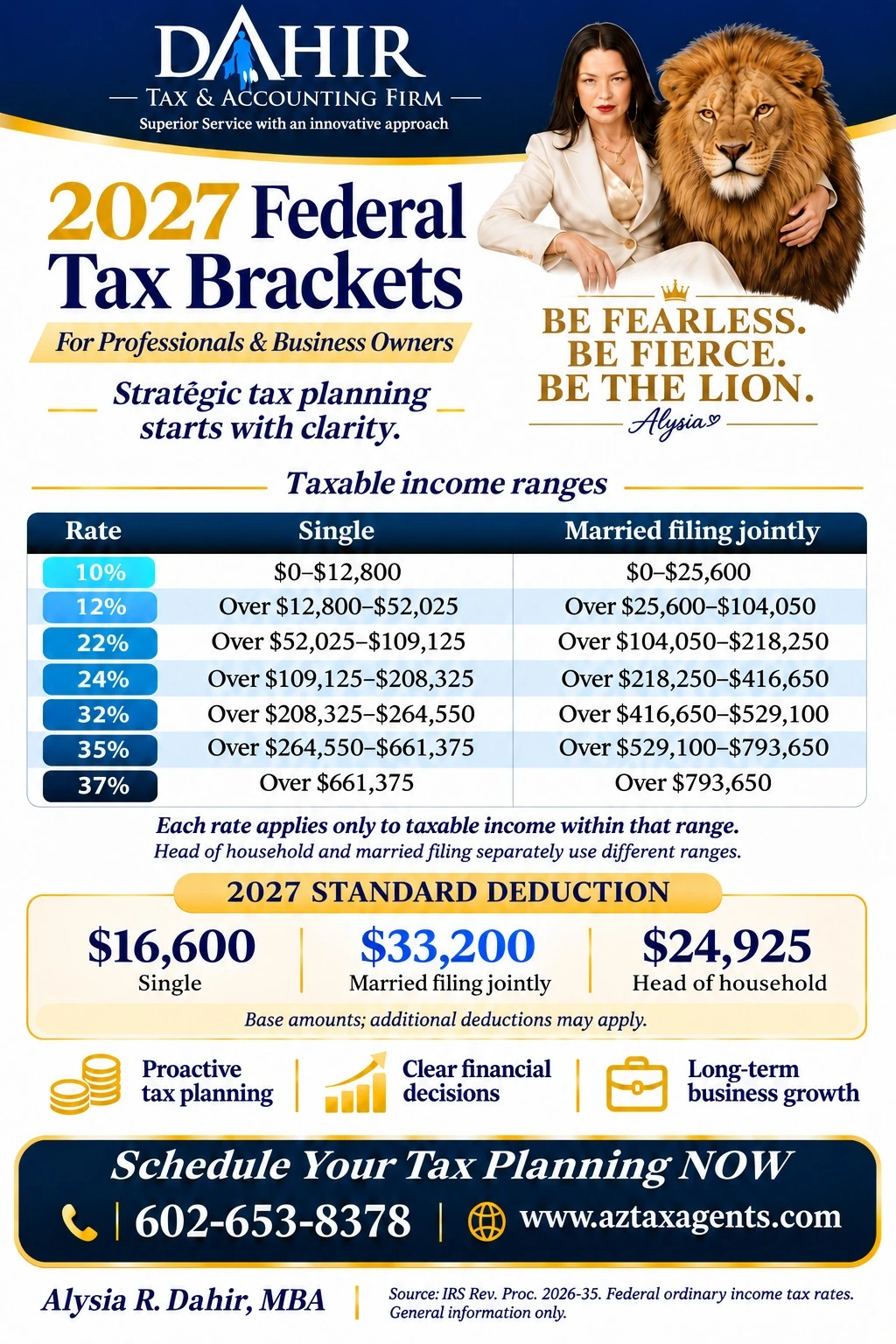
The IRS announced the 2027 federal income tax brackets on November 5, 2026, and the seven tax rates stay at 10%, 12%, 22%, 24%, 32%, 35%, and 37% while every income threshold moves up.
The standard deduction climbs to $16,600 for single filers and $33,200 for married couples filing jointly, according to IRS Revenue Procedure 2026-35. These figures apply to income earned in 2027 and to returns filed in 2028, so the return you file this spring still uses 2026 numbers.
Dahir Tax & Accounting Firm put together this breakdown so you can see what the changes mean for your paycheck and your planning.
Key Points
- Tax rates stay the same, but every bracket threshold rises about 3.2% for 2027.
- The standard deduction grows to $16,600 for single filers and $33,200 for joint filers.
What are the 2027 federal income tax brackets?
The 2027 brackets keep seven rates and push every threshold higher, with the 37% rate starting at $661,375 for single filers and $793,650 for married couples filing jointly. The table shows the taxable income where each rate begins, with 2026 figures beside the new ones.
| Rate | Single 2027 | Single 2026 | Joint 2027 | Joint 2026 |
|---|---|---|---|---|
| 10% | $0 | $0 | $0 | $0 |
| 12% | $12,800 | $12,400 | $25,600 | $24,800 |
| 22% | $52,025 | $50,400 | $104,050 | $100,800 |
| 24% | $109,125 | $105,700 | $218,250 | $211,400 |
| 32% | $208,325 | $201,775 | $416,650 | $403,550 |
| 35% | $264,550 | $256,225 | $529,100 | $512,450 |
| 37% | $661,375 | $640,600 | $793,650 | $768,700 |
Sources: IRS Revenue Procedure 2026-35 for 2027 and IRS Revenue Procedure 2025-32 for 2026. Dahir Tax & Accounting Firm calculates the single filer thresholds rising between 3.2% and 3.3%.
Each rate applies only to the slice of income inside its bracket. A single filer with $60,000 of taxable income pays 10% on the first $12,800, 12% on the next $39,225, and 22% on only the last $7,975.
How much does the standard deduction increase?
The standard deduction rises $500 for single filers, $775 for heads of household, and $1,000 for married couples filing jointly. Here are the 2027 amounts:
- Single and married filing separately: $16,600 (up from $16,100)
- Head of household: $24,925 (up from $24,150)
- Married filing jointly: $33,200 (up from $32,200)
An extra $1,000 for a married couple sounds small. At the 22% rate it trims the tax bill by $220, and it arrives automatically, with no form to fill out.
What does the 2027 adjustment mean in dollars?
A single filer with $80,000 of taxable income owes $170.50 less federal income tax under the 2027 schedule than under the 2026 schedule. The comparison below holds taxable income constant and ignores credits.
| Schedule | 10% slice | 12% slice | 22% slice | Total tax |
|---|---|---|---|---|
| 2026 | $1,240 | $4,560 | $6,512 | $12,312 |
| 2027 | $1,280 | $4,707 | $6,154.50 | $12,141.50 |
Married couples see a larger dollar change because the joint brackets are wider. A couple filing jointly with $150,000 of taxable income owes $22,424 under the 2026 schedule and $22,083 under the 2027 schedule, a drop of $341.
Our view at Dahir Tax & Accounting Firm: $170 does not justify restructuring anything. The adjustment matters more as a guardrail.
Forbes reported on November 5, 2026 that the IRS made larger adjustments for 2027 than for 2026 because inflation ran higher, and the indexing exists to stop bracket creep, where a raise that only keeps pace with prices pushes income into a higher bracket.
Which credits and limits change for 2027?
The maximum Child Tax Credit increases to $2,300 for 2027, up $100, and the refundable portion rises to $1,800. The IRS also moved these figures:
- Earned income tax credit maximum: $8,496 for taxpayers with three or more qualifying children, up from $8,231
- Estate tax basic exclusion: $15,480,000 for deaths in 2027, up from $15,000,000
- Annual gift exclusion: $20,000 per recipient, up from $19,000
- Alternative minimum tax exemption: $93,000 for unmarried individuals and $144,700 for married couples filing jointly
- Health FSA salary reduction limit: $3,500, up $100
- HSA contribution limit: $4,500 for self only coverage and $9,000 for family coverage (Revenue Procedure 2026-24)
- Section 179 expensing limit for businesses: $2,640,000, up from $2,560,000
What stays the same in 2027?
The tax rates, the $0 personal exemption, and several deduction caps from the Working Families Tax Cuts stay where they are.
Forbes reports that the $6,000 senior deduction, the $25,000 cap on the tips deduction, and the $12,500 overtime deduction cap ($25,000 for joint filers) are fixed dollar amounts that did not increase for 2027. Each of those deductions carries its own eligibility rules, so ask before you assume you qualify.
How should you prepare before January 1, 2027?
Check your Form W-4 withholding and estimated tax payments now, because the new thresholds change how much federal tax a given salary owes.
- Compare your year to date taxable income with the 2027 thresholds to see which bracket your next raise lands in.
- Run a draft estimate in tax software such as TurboTax, H&R Block, or TaxAct once each program updates for the 2027 tax year.
- Book a planning call with Dahir Tax & Accounting Firm if you expect self employment income, a business sale, or large capital gains.
Bracket edges deserve a second look. A single filer with $52,000 of taxable income sat in the 22% bracket for 2026, because that rate starts at $50,400. The same $52,000 stays inside the 12% bracket in 2027, since the 22% rate does not start until $52,025.
Conclusion
The 2027 brackets keep every rate in place, raise every threshold about 3.2%, and trim the federal tax bill slightly for anyone whose income stays flat. Dahir Tax & Accounting Firm can run your numbers before year end so you know exactly where you land.
Sources: IRS news release IR-2026-133 and Revenue Procedure 2026-35 (November 5, 2026); IRS Revenue Procedure 2025-32; IRS Revenue Procedure 2026-24; Forbes (November 5, 2026).